
Utility programs, delivered at checkout
Rebates at checkout, or claimed after a purchase anywhere.
An instant rebate is applied at checkout on the marketplace; a Fast Track™ rebate is claimed after a purchase anywhere, by uploading the receipt. Both run on one platform, with one eligibility check and one claim history, so the same purchase cannot be paid twice. Receipts are verified in less than half the time of the manual queue this replaced.
- 39M+
- households reached
- 2 → 1
- delivery modes, one claim history
- Receipt read and matched to the catalog
- Service address checked against every prior claim
- Eligibility confirmed against your customer records
The same rebate, on the same model, either way.
The problem
Two systems, two answers about the same customer.
When instant delivery and post-purchase claims run on separate systems, eligibility gets evaluated twice by two sets of logic, and each system checks a claim against only its own history.
The customer record is split, so the reconciliation is manual, and the gap between the two systems is where duplicate claims and slow turnaround start. This is an architecture problem, not a processing problem, and processing faster will not fix it.
How it works
Both modes use one eligibility check, one catalog and one claim history.
A purchase on the marketplace and a purchase made anywhere else arrive at the same place. The two modes differ only in when the customer sees the money; what qualifies and how it is verified are the same.
Bought on the marketplace
The incentive comes off the price before checkout.
Bought anywhere else
The customer claims it afterwards through Fast Track™.
Everything is decided once
- Eligibility checked against your customer records
- The model matched against the Choice Engine® catalog
- The claim written to a history both modes read
One rebate
At your approved incentive level, counted once.
Why it matters
One architecture handles the hard parts.
-
Stacking
Incentives stack by customer, not by lookup table
Utility, government and manufacturer incentives combine according to the customer's segment, at the transaction. An income-qualified adder and a manufacturer promotion apply to the same order, and no program manager has to work out the combinations in advance.
-
Tax
Each rebate gets the right tax treatment
Pre-tax and post-tax treatment is applied correctly per incentive. Getting it wrong surfaces later as a reconciliation the program has to absorb.
-
Certainty
Claims are matched to the catalog
A claim is checked against the same Choice Engine® catalog the marketplace sells from, so a customer learns at claim time whether their model qualifies, before the program counts it.
-
Integrity
A purchase cannot be claimed twice
Both modes write to one claim history, and every claim is checked against every prior claim for that service address. Caps hold across the two modes because there is only one place a claim can be recorded.
Verification
Watch it read a receipt.
Post-purchase claims are verified by an AI model that reads the receipt — retailer, date, order number, line items, prices. It is in production in the back office, and it completes verification in less than half the time the manual queue took.
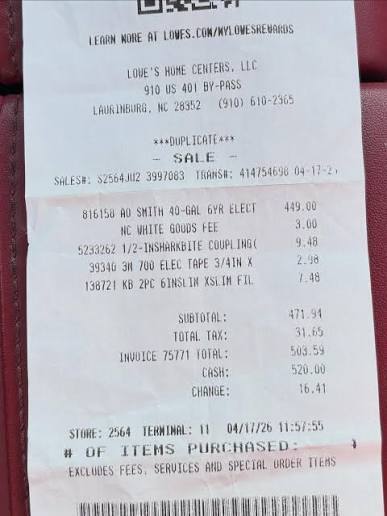
Fields below were extracted from the receipt image by the verification model, then matched against the Enervee catalog.
- Retailer
- Lowe's Home Centers · Laurinburg, NC
- Purchase date
- 17 April 2026
- Transaction
- 414754698 · Store 2564
- Manufacturer
- A. O. Smith
- Model
- E6-40R45DV · 40-gal electric (Lowe's item 816158)
- Product cost
- $449.00 — fees and fittings excluded
- Catalog match
- Found — Enervee Score 62, medium efficiency choose.enervee.com
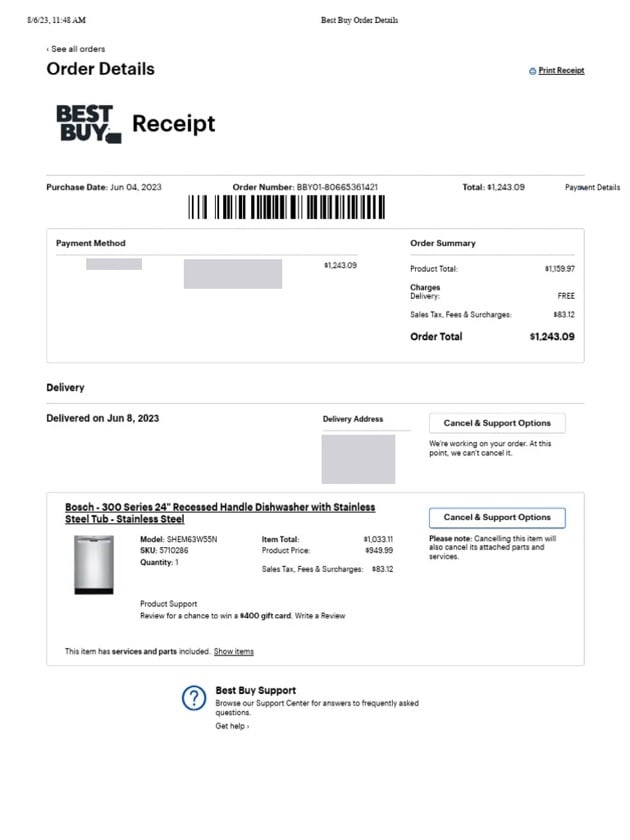
Fields below were extracted from the receipt image by the verification model, then matched against the Enervee catalog.
- Retailer
- Best Buy · online order
- Purchase date
- 4 June 2023 — outside the claim window
- Order number
- BBY01-80665361421
- Manufacturer
- Bosch
- Model
- SHEM63W55N · 300 Series 24" dishwasher (SKU 5710286)
- Product cost
- $949.99 — tax and fees excluded
- Catalog match
- Found — discontinued model, no longer scored
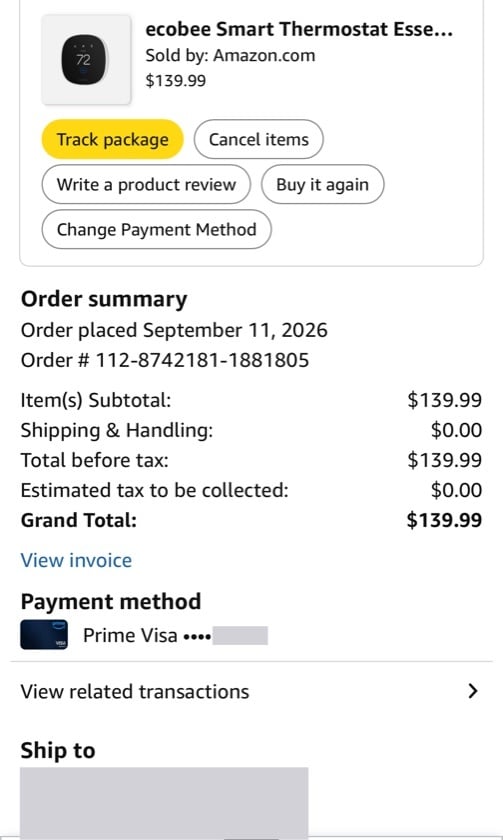
Fields below were extracted from the receipt image by the verification model, then matched against the Enervee catalog.
- Retailer
- Amazon.com · app order screenshot
- Purchase date
- 11 September 2026
- Order number
- 112-8742181-1881805
- Manufacturer
- ecobee
- Model
- EB-STATE7-01 · Smart Thermostat Essential
- Product cost
- $139.99
- Catalog match
- Found — Enervee Score 100, ideal efficiency choose.enervee.com
- Eligibility
- Efficiency rebate + demand response enrollment incentive
Real receipts. Customer names, addresses and card digits are redacted.
Program rules
Your rules, applied at the transaction or at claim.
| Rule | Enforced as | When |
|---|---|---|
| Caps | By category, per household, on a program-year or multi-year lookback | At the transaction |
| Price ceiling | Rebate capped at the actual purchase price; rewards and points redeemed are excluded from the paid price | At the transaction |
| Documentation | Itemised receipt or invoice showing retailer, address, manufacturer, make and model, cost and purchase date; order confirmation for online purchases; altered or illegible documents rejected | At claim |
| Exclusions | Resale, leased, rebuilt, rented, warranty-replacement, gifted and prize units screened out | At claim |
Card data never touches our systems — payments run through Stripe, and no card or loan data is stored. Customer data is handled under CCPA, GLBA and GDPR.
Across your portfolio
One delivery mechanism, whichever budget line it serves.
-
Efficiency
Appliances, HVAC and water heating at your approved incentive levels, with no change to workpapers or approved measures.
Water heater programs → -
Demand response
The rebate and the demand response enrollment go on the same order, so one acquisition serves two program measures.
Demand response & VPP → -
Resilience and preparedness
Portable power stations, generators, air purifiers, room ACs. They need no efficiency rating, TRM line or ENERGY STAR tier, and they run on the same platform.
Resilience & preparedness → -
Income-qualified
Incentives stack by customer segment, so the income-qualified adder applies automatically, with no second application.
Income-qualified programs →